June 21, 2018
Horror films come in many forms. Over the years, there had been adventure horror films ("Cloverfield," "Anaconda"), comedy horror films ("Scream," "Scary Movie"), religious horror films ("The Exorcist," "Rosemary's Baby"), crime horror films ("Saw," "Silence of the Lambs"), or science fiction horror films ("Alien," "Life"), among the more common kinds. But once in a rare while you will encounter a horror film that defies any specific form of horror classification. "Hereditary" is one of those.
Miniature artist Annie Graham lived with her husband Steve and their two kids, teenage son Peter and 13-year old daughter Charlie. Annie was already undergoing a major emotional crisis when her mom Ellen passed away, when another unspeakably shocking death followed within a few days which pushed her into a major breakdown. Annie tried advice from a friendly lady from the grief support group Joan (Anne Dowd) on how to move on, but mysterious events continue to escalate within their household.
As Annie, Toni Collette seethed with with bottled-up anger and frustration for the first half of the film, until she just erupted with pure emotional fire in that dinner table scene. That would remind people that she once had an Oscar acting nomination in 1999 as Cole's mother in "The Sixth Sense." Collette totally dominated this movie with the paranoia and hysteria that ate at her with ghastly consequence. She did have some awkward scenes, like the seance or the fireplace, probably because of how they were written.
The last film I remember Gabriel Byrne in was "The Usual Suspects" and that was way back 1995. He never had another role of consequence after that that is why I did not recognize him at once as Annie's reticent husband Steve. He also did not really do much here though.
I was distracted that the actor playing Peter, Alex Wolff, did not really look like he could be the son of Collette and Byrne. As a teenager consumed by traumatizing guilt, Wolff had a very challenging role to portray, but it tended to be uneven, especially those scenes where he was sobbing. On the other hand, Milly Shapiro, in her film debut, played the withdrawn youngest daughter Charlie. With her unusual facial features, Shapiro was able to effectively project Charlie's troubled soul.
Annie had a fascinating job making miniature dioramas. That gave a unique set design that felt like their whole house was one of the doll houses Annie was building, like there was some outside sinister force playing them. The cinematography in near pitch black, as well as the unobstrusive musical score, were both very arthouse in approach, but for me, effectively done. I don't know if the sound was purposely toned down to almost whispers, but at times the words were not clear enough to understand.
Despite the effort to create a sense of realism to enhance the dramatic tension, there were a number of scenes that were not logical in reality, like how major accidents were processed by authorities or how severe physical injuries were managed medically. Also, that crazy off-the-wall ending is bound to polarize audiences, definitely not for everybody. I also have a feeling that many may hate it because of its glacial pace and quietness.
This film written and directed (in his feature debut) by Ari Aster had a dark and oppressive atmosphere from beginning to end, and this was its most distinctive and unsettling character. The horror was happening in more than one level, and you are never sure where it was coming from until some revelations in the final scenes. Even then, you would still leave the theater boggled about the intense, nightmarish experience you just went through the past 127 minutes. I liked it because I got creeped out. Despite its plot faults, it gets its job done as a horror film for me. 7/10.
June 20, 2018
It has been 11 years since the last film of Steven Soderbergh's "Ocean's" trilogy. which started with "Ocean's Eleven" (2000), then "Ocean's 12" (2004) and "Ocean's Thirteen" (2007). The series starred superstars George Clooney, Matt Damon and Brad Pitt, and set a pretty high bar for classy heist movies. This year, maybe in tune with the recent trend for female empowerment, a spin-off with an all-female cast was released to perhaps revive the trend set by its predecessor.
Danny Ocean's sister Debbie (Sandra Bullock) was just released from incarceration for a major case of fraud. Still a natural con-woman to her core, she had been planning a big heist in her head all those five years she spent in jail. So the momentDebbie was out, she got together with her old girlfriend and partner in crime Lou (Cate Blanchett), to set her major big-time plan in full motion.
She got her team together: fashion designer Rose Weil (Helena Bonham-Carter), jeweler Amita (Mindy Kaling), tech-savvy hacker Nine Ball (Rihanna), skilled pickpocket Constance (Awkwafina) and fence Tammy (Sarah Paulson). Her goal: to steal the multi-million dollar Cartier Toussaint diamond necklace while it is being worn on the neck of celebrity Daphne Kluger (Anne Hathaway) during the Annual Met Gala.
Sandra Bullock does not in any way look like she could be a sister of George Clooney, but like in all her other films, she can really make any character likable. I wanted to see her intricate plan come together, and was hanging on to every piece of the puzzle as they fit in to complete the picture.
The other character I liked was that played by Anne Hathaway, another actress whose goodwill alone can save any role she was playing. She played Daphne with her tongue completely in cheek, like it was a satire of any of those vapid self-centered celebrities who only care about how they look during events.
The other gals were just introduced too quickly for us to know them better and care about them more. Cate Blanchett's Lou was her usual strong and capable persona. Helena Bonham-Carter's Rose was her usual kooky and eccentric persona. Rihanna's Nine Ball was the usual cool as a cucumber techie. Nine Ball had a younger sister who just so happened to be a magnet expert when they needed one -- now that one was hard to buy.
Mindy Kaling's Amita was the usual mousy spinster with mommy issues. Awkwafina's Constance was really an uncomfortable screen presence, and she looked out of place among the other ladies. Sarah Paulson's Tammy conveniently had the technology or the connections needed to achieve certain aspects of their plan. At times, this could a bit too convenient for comfort.
I was pleasantly surprised with the 11th hour appearance of James Corden as insurance investigator John Frazier. Of course, he was practically acting like he does in his TV show, but still, so funny. The other male of note in the cast is Richard Armitage, who played the charming but unscrupulous art dealer Claude Becker, who had once had an entanglement with Debbie five years ago.
I really enjoyed watching this smart caper unfold, as told by writer-director Gary Ross. Say what you will about crime does not pay, but I was actually rooting for Debbie and company to get away with it all. The sneak peek into the super exclusive Met Gala (which was just hot in the news and social media last month) was a bonus, along with the cameos of the glamorous celebrities who frequent this fashion event like Heidi Klum, Serena Williams, Kim Kardashian, among others.
Just like "Ghostbusters" before it though, this film will inescapably also be compared to the original all-male gang. For sure, these awkward assembly of ladies could not keep up with the more dapper charm of their male counterparts. However, they do have their own sense of delightful fun and cleverness that carried the film through. I am hoping for a sequel with a better-plotted, more complex heist story to further challenge the talent of the cast. 7/10.
June 19, 2018
"Escape Plan" (Mikael Håfström, 2013), an action film starring Sylvester Stallone and Arnold Schwarzenegger, was a pleasant surprise for me (MY REVIEW). Stallone was Ray Breslin, a security expert, who believes that there is no prison from which he could not escape from. Despite the obvious B-movie vibe, this film was unexpectedly entertaining and smart, a great watch. I did not expect a sequel, but why not?
Ray Breslin is back as the head of a team of security experts. One of his skillful operatives, Shu Ren, was kidnapped with his tech-savvy cousin, apparently held captive in a high-tech secret prison called Hades. Unlike most prisons, it did not seem to have a specific location, a specific routine or any possibility of inside or outside help that Shu could figure out. Breslin needed to execute an elaborate Plan B to get Shu out.
The first half of the film was focused on Shu (Huang Xiaoming) and how his mind worked to analyze Hades out for a way out. This part of the film actually felt like a Chinese martial arts film. Shu had to rely on his wu-xia fighting skills to win "battles" with fellow inmates in order to gain "sanctuary" time. With the Chinese producers in the credits and all, it actually felt like we were watching a Huang Xiaoming movie, as this guy is a star in his own right in China.
Stallone's action scenes came in only in the second half when it was obvious to Breslin that he needed to enter Hades himself in order to get Shu out. Dave Bautista actually had a very short screen time despite his co-top-billing. Bautista played Trent DaRosa, one of Breslin's old mercenary friends who got roped into the action. The other actors (Curtis "50 Cent" Jackson, Jesse Metcalfe, Jaime King and especially the cheesy Wes Chapman as Kimbral) were not too impressive.
This sequel by Steven C. Miller was a major downer when compared to the first film. It felt disjointed and confused, like two different movies jammed into one. Their escape plan itself was not too well-conceived, a bit too convenient, which was disappointing. Via a comparison of their business operations with a game of Go, there were some moments of zen philosophy to sprinkle a modicum of intellect amidst the mindless violence.
The bad guy and his motive were obvious from the get-go, so it was annoying how he still got as far as he did. The "sci-fi" parts were unconvincing with just a lot of flashy but unimpressive lighting and special effects. The martial arts fight scenes with Huang were not bad, just with a lot of "bone-crunching" sound effects to embellish them. The ending seems to suggest a Part 3, but this forced sequel does not exactly convince us to look forward to it. 4/10.
June 17, 2018
If I would rank all my all-time favorite Pixar films, "The Incredibles" (2004) would figure in my Top 5. That film written and directed by Brad Bird was about the Parrs, a family of superheroes who were forced by law to suppress using their powers and lead regular lives. Aside from frenetic action scenes and a great sense of clean humor, it also had poignant drama that centered on family values. I never expected for it to have a sequel at all, until first teasers came out late last year.
This sequel picked up where the first film ended, with the Incredibles and Frozone (Samuel L. Jackson) battling the super-bank robber Underminer (John Ratzenberger) . The heroes prevailed in th end, but the Underminer was able to escape with the loot. The massive destruction of the city after their fight resulted in the superheroes being permanently banned from using their powers anymore.
In order to restore the trust and good will of supers to the public, telecom tycoon superhero fan Winston Deavers (Bob Odenkirk) and his technical genius sister Evelyn (Catherine Keener) invited Elastigirl to openly foil high profile crimes using her powers. While his wife Helen (Holly Hunter) was singlehandedly fighting the hypnotizing villain Screenslaver (Bill Wise), Bob (Craig T. Nelson) had to stay at home to take care of the kids.
The film had a feminist message in its agenda. It showcased Elastigirl's solo crime-fighting prowess and put Evelyn Deaver's innovative telecommunications inventions in the forefront. Among the new superheroes, it was Voyd (Sophia Bush), and her ability to create holes where objects can appear and disappear at her will, who got the major supporting role in the fight scenes. Violet (Sarah Vowell) made the first move in reconnecting with her crush Tony. Edna Mode (Brad Bird) is well, Edna Mode, enough said.
The focus on Bob Parr was more of him being a father than as a superhero. Mr. Incredible was hardly in on much of the fighting action. A major part of the film was about him discovering Jack Jack's crazy superpowers when the baby got into a serious tussle with a raccoon. He also had to deal with Violet's budding romance woes and tutor Dash his math. You would not expect who Bob got to babysit Jack Jack when the whole fatherhood job got real tough for him. This aspect of the film made its release on Fathers Day just perfect.
After a gap of 14 years, the expectations for the sequel do tend to run very high. However, with the gamut of superhero films that came and went in that time, it was difficult to tell a completely original superhero story anymore. The topic about humans versus the supers echoed the conflicts already explored at length in the "X-Men" and the "Avengers" franchises. The "mysterious" villain was already so obvious from when the character was first introduced, so the revelation was not so surprising.
It was also disappointing to see fewer scenes of the whole Parr family working as a team fighting the bad guys. Most of the exciting, incredibly choreographed action scenes were those of Elastigirl and Frozone. Mr. Incredible mostly on the sideline fight-wise until his climactic rescue scene at the end. There were also so many busy scenes featuring several new heroes (Voyd, Helectrix, Krushauer, et al) and their varied powers, thus reducing the fighting time of Violet and Dash.
Anyhow, the Pixar-quality creativity in artwork, the thrilling action sequences, the affecting family drama and the amusing humor are all still on point for our entertainment. Despite the familiarity and predictability of the plot, Brad Bird certainly made the whole film exciting and fun for the whole family to enjoy together. By the way, they still have not caught the Underminer, so does that mean we are still looking forward to a Part 3, maybe another 14 years from now? 8/10.
*****
Accompanying "Incredibles 2" is "Bao," an animated short about a lonely Chinese housewife whose homemade dumpling ("siopao" in our vernacular) comes to life and becomes her son. The animation of the siopao growing up is very cute and delightful. The story about a mother's love is poignant and heartwarming, tears will well. This film by Chinese-Canadian director Domee Shi (Pixar's first female director of an animated short) will surely to be a contender in the Animated Shorts category come Oscar time next year.
June 15, 2018
Three years ago, the original 1993 "Jurassic Park" film franchise was reborn as "Jurassic World" introducing us to new characters like dinosaur park manager Claire Dearing, dinosaur trainer Owen Grady and his dearest pet and trainee, a velociraptor named Blue. These three are back again this time for a new adventure, without the park. Frankly, I went into theater not expecting too much based on the trailer.
Three years after the events of the last movie, the very existence of Isla Nublar and its dinosaur residents are under threat by a cataclysmic volcanic eruption. Claire, now a dinosaur rights activist, was convinced by lawyer Eli Mills (representative of Benjamin Lockwood, estranged business partner of Jurassic Park originator John Hammond) to help them save some dinosaurs from extinction.
Passionate to save the dinosaurs, Claire sought the help of her old friend Owen to embark on the rescue mission with her, together with her paleo-veterinarian Dr. Zia Rodriguez and IT specialist Franklin Webb. Of course, the specter of human greed would again wave its arms in more sinister ways than ever, as the science of dinosaur genetic engineering was being pushed to serve megalomaniac pursuits of business and warfare.
After going over-the-top on the amusement park concept in the last film, this new sequel goes into darker ethical issues which were only hinted at in passing in previous installments. Here, the various dinosaurs were captured and were being sold on the black market for mega-bucks for all sorts of underhanded purposes. With all the firepower around now, I seriously doubt the practicality of having a dinosaur as a weapon of mass destruction in the modern world. Dr. Ian Malcolm offered philosophical insights about this technology when he served as resource person in a Senate inquiry.
In place of the departed Indominus Rex from the last time, there is a prototype of a more vicious, more intelligent hybrid between Indominus and a Velociraptor called the Indoraptor, to give the major dino scares. Honestly, it was just more of the same thing we have seen over and over already in all the past episodes of this franchise. They really did not show much innovation in the dinosaur department this time around.
Chris.Pratt's Owen is still the same likable chap, with his amusingly expressive face. Howard's Claire was less annoying now without her stilettos. Daniella Padilla's Zia was supposedly a paleo-veterinarian, but despite her degree, she said she'd never seen a real dinosaur before. I wonder how she learned her dino surgery skills in the university? Justice Smith's nerdy Franklin was the token nervous wreck character and the main comic relief. They all led charmed lives apparently, so there was no sense of real danger whenever they tangle with dinos.
With Steven Spielberg as one of the producers, a major child character is expected, and there was one here, in the person of spunky Maisie Lockwood, played by Isabella Sermon in her film debut. Despite her tender age, little Maisie was no shrinking violet. Like a mouse, she could fearlessly scale the window ledges and run across narrow beams from the top levels of their mansion. She had presence of mind even in the face of mortal danger, which we had no doubts she would survive every time.
The villain characters played by Rafe Spall, Ted Levine and Toby Jones were obvious from the get-go and we knew they were all going to end up as dinosaur fodder, as all the bad characters in the past all ended up. It was just a question of how they will go into the carnivorous dino's mouth that kept us riveted on the screen during those tense moments.
However, there is nothing really new here anymore. They've stretched the material too much already and the strain is showing. It was actually repeating dino fight scenes from previous films. Spanish director J.A. Bayona did his best to keep things entertaining and engaging, so we all still had fun with the thrills and scares he served up (especially in the first 15 minutes). The very short extra scene at the very end of the closing credits teased a curious scenario which surely will make us return to watch the third, and hopefully final (for now at least), chapter of this franchise, scheduled for release in 2021. 6/10.
June 2, 2018
It had already been a year last May 23 that the tragic and destructive siege of Marawi City by the Maute group (local operatives under the banner of the ISIS terrorist organization) began. This was a heinous and prolonged act of terrorism that that claimed the lives of about a thousand Filipinos (soldiers, terrorists and civilians) and left a major city in ruins.
Just a few months after the siege was declared over by the President last October 23, this film (directed by a veteran journalist Caesar Soriano based on his personal experiences on the field) about it came out. Initially, I had my doubts about the cinematic quality of this indie film tackling such a big formidable story, but I got intrigued enough to go watch it when I found out that the main character was going to be a nurse.
Sajid Tumawil (Martin Escudero) had been working as a nurse in the Abu Khalid Hospital in Marawi City. Blinded by rage and a desire to avenge the murder of his father by the military, Sajid had undergone indoctrination and training with a Muslim extremist group under his uncle Kumander Espi (Jordan Castillo). When the war erupted in Marawi, Sajid had to divide his time and loyalty between the hospital and the radicals who sponsored his education.
As a counterpoint to Sajid, the film offered the story of Lt. Kent Samonte (Juan Miguel Soriano), a Catholic soldier sent to fight in Mindanao under the command of Maj. Gen. Ricky Manabat (Rez Cortez). When Kent was injured in an encounter with Muslim rebels, he was cared for in the Abu Khalid, where Sajid was his nurse-in-charge. While Sajid tended to Kent's injuries, the two would discuss their philosophies about their jobs and their duties
Lead actor Martin Escudero gave such a hammy, troubling performance overall, so unlike his appealing turn in "Zombadings" (2011). Veterans like Rez Cortez, Tanya Gomez and Darius Razon (as Sajid's parents) also went over-the-top. From the lesser-known actors in the cast, let's just say there were no pleasant surprises.
The melodramatic script by Dave Castillo was well-meaning, but shallow, messy and cliched. While we appreciated the sentiments about soldiers, duty and country, we had heard all of these before, and wished for a more novel approach on the topic. There were some uncomfortable scenes showing Muslim stereotypes. Like, did we really need that cringy scene where a leery Sajid was trying to court a Catholic nurse?
Could it have gone deeper into the philosophy of the Muslim militant extremist rebel group? How did this group develop had that violent frame of mind that true Islam never espoused? Instead, we only see them recruiting young Muslim teenagers as members, which we already know from the news. However, it did not offer any deeper insights into how they indoctrinated and trained Sajid.
To their credit, there were at least two scenes which I thought were well-shot, well-acted and well-written. One was the scene between Sajid and the Imam Mukaran (Lou Veloso) where the wise man offered Sajid not only moral enlightenment, but revealed some hard truths. The second was a bold confrontation scene between Sajid and his mentor Kumander Espi, which irreversibly overturned the tide of confidence between the two men.
On paper, the story was interesting enough as the plot of a full-length film. However, on the aspects of the script and its technicalities of execution, this film was sadly amateurish, which was a shame, and a waste of potentially good material. 4/10.
June 1, 2018
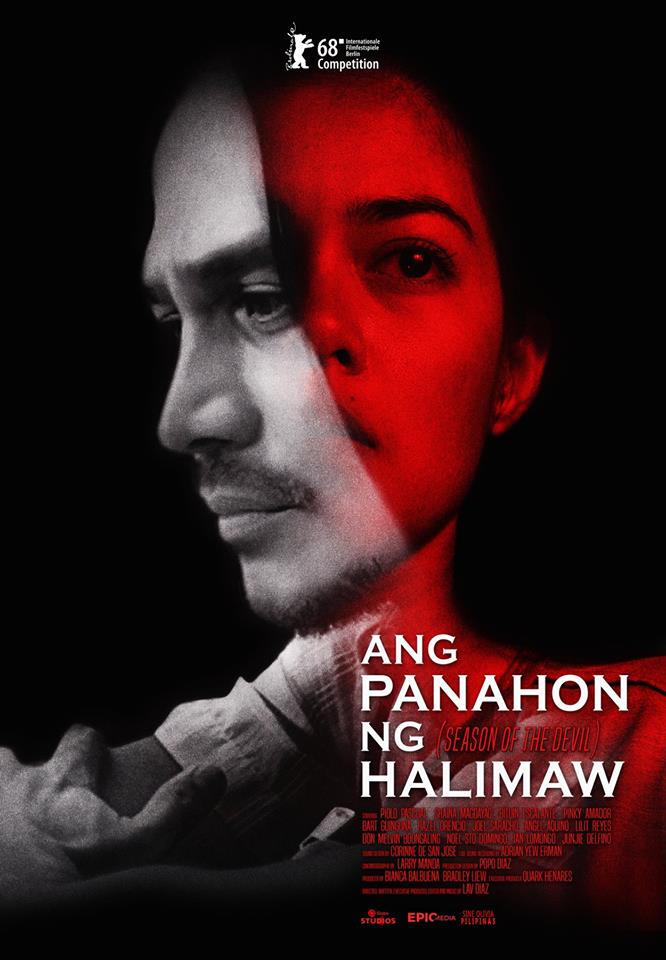
Before this, I had already seen four other Lav Diaz films: "Norte" (2013), "Mula sa Kung Ano ang Noon" (2014), "Hele sa Hiwagang Hapis" (2016) and "Ang Babaeng Humayo" (2016). For those four films alone, I had spent 250 + 338 + 485 + 228, a total of 1301 minutes inside movie houses to watch them. With the additional 234 minutes invested in this latest opus, I had already more than a full day (or 25 hours and 35 minutes) of my life for Lav Diaz films.
It was 1979. PD 1016 providing for the creation of Civilian Home Defense Forces was already in full swing and causing fear and anarchy in various places in the country. Young Dr. Lorena Haniway volunteered her medical services for the barrio of Ginto located somewhere in the Southern Philippines. She was repeatedly harassed by Chairman Narciso and his paramilitary forces controlling that barrio, until one day she just disappeared. Her distressed husband, Hugo, a political activist and poet, came to Ginto to look for her.
The political messages of this film was clearly stated from within its first half hour. This was about people who suffered atrocities under the hands of paramilitary forces during Martial Law. Via a lengthy brutally frank poem recited by Hugo, Diaz did not beat around the bush to extrapolate these abuses and injustices to various personalities (the clues were not subtle) who run the current government. The literally two-faced Chairman Narciso (Noel Sto. Domingo) always shouted in gibberish and promoted violence, yet he had adulation of the masses. Any guess who this guy was supposed to represent?
To innovate from his previous works, Diaz put the dialog of this films into song, calling this film an rock opera. This is in a capella, however, so don't expect anything grand and bombastic like "Jesus Christ Superstar". The tunes of Diaz's songs sound like simple variations of one basic tune and were rather singsong in manner of execution. There were all somber in mood and downcast in spirit.The lyrics were mostly repetitive, mostly with unwieldy rhymes. Entire stanzas were simply repeated three or more times at a time within the song. Entire songs were repeated in toto in different parts of the movie.
There was this one recurring refrain, where the various characters would awkwardly chant "la, la, la, la". Hearing these syllables sung sounded very surreal, given the situations they were sung in -- like heated interrogations and vicious tortures. These were moments of nervous comic relief for me. These were sung monotonously by Hazel Orencio (as Teniente or Lieutenant), Joel Saracho (as the scar-faced Ahas or Snake) and writer Lilit Reyes (as the most lecherous among the militiamen). They had one song though that broke the usual mold, and that was the sleazy "Talampunay Blues" which they sang during a long disturbing scene of hallucinogenic drug-laced sexual assault.
Most of the songs that stood out for me were sung by Bituin Escalante, who was credited as "Kwentista" (or Narrator). Her very first song was the best song of the film for me -- a bitter love song asking what will happen when there is no more color, light, melody or heart in the world. She also sang about the sad story of Aling Maria and her missing son Porfirio; as well as a ballad about love without fulfillment. Escalante sang these plaintive tunes with such raw emotions, such that her voice even seemed to be at the brink of breaking (but of course, it did not, given her excellent control of her vocal instrument).
Theater veterans Pinky Amador and Bart Guingona also get to sing some very serious songs which state strong political conviction. Amador played the role of Aling Sinta, a Sisa-type woman whose her husband and son were summarily executed and labelled as rebels. In turn, she accused to be a "Kuwago" (or Owl), the devil personified. She sang about not sitting still and fighting for justice. Guingona played a Pilosopo Tasio-type of character called "Paham" (or Wise Man). He sang to a song to wake up the sons of the country. At one point, he slyly broke the fourth wall and addressing the audience directly.
Shaina Magdayao as Lorena represented the idealistic youth. All she wanted was to be of service to the poor, and she was steadfast in her resolve to stick to her volunteer mission, despite the odds. She had been warned to stay away, directly, many times, yet she paid no heed. Her performance was the most straightforward and typical, most grounded in reality. Her songs were very heartfelt, like that of her letter to her husband, and that one when she was in desaparecido limbo.
Piolo Pascual, portrayed his character Hugo the best he could, even if this character was the most puzzling and incomplete one of all in the film. There were a lot of missing chunks in his hollowed-out story. Why were we shown Hugo as a young boy flying paper planes in the forest? What was that creature he met wearing a black cape and a beaked mask? Was Hugo admitted into the hospital two separate times? Who exactly was Angel Aquino's character in Hugo's life? Why did it take Hugo three years before deciding to follow Lorena up into Barrio Ginto? The answers to these questions in scenes seem to have been left cut on the editing room floor.
I confess that I really felt the time ticking away so much slowly while watching this one. I felt that the story was relatively simple, even predictable, yet so stretched out, sometimes too much, with instances of lackadaisical singing of redundant words and songs. Each hour alone felt like two. Even if it is relatively shorter in running time, It was more challenging for me to sit through this one compared to the other longer Lav Diaz films I had watched before.
Fortunately, there were those special moments when Lav Diaz's artistic genius shone through in his unconventional camera imagery and technique, as well as in his inspired music and lyrics in certain songs. These still made the four hours worth the long while, right down to that abrupt, open and haunting ending. For purely artistic merit, 6/10 . Your own convictions will dictate your personal rating about its political agenda.
May 31, 2018
The first Wes Anderson movie I had ever seen was "The Fantastic Mr. Fox" (2009). This was a charming stop-motion animated film (adapted from a book by Roald Dahl) about a sly fox thief, his wife, family and the farmers he stole from. This year, Anderson comes back from a four-year directorial hiatus (since his triumphant "The Great Budapest Hotel") with another stop-motion animated film about animals (this time it was about dogs) and the humans they go up against.
The was an epidemic of dog-flu in canine-saturated Megasaki City. With no cure forthcoming, its despotic Mayor Kobayashi decreed that all dogs should be exiled to the stark and barren Trash Island. There on the island, the dogs (most of which lived comfortable lives before as house pets) led in a sad sorry existence, even having to go around in packs to fight over scraps of food just to survive.
One day several months later, a little pilot landed on the island on a plane he had hijacked. He was Atari Kobayashi, the mayor's 12 year old nephew, who had come in search of his bodyguard dog Spots. A pack of alpha-dogs (King, Rex, Boss, Duke and their tough, macho black-haired leader Chief) decided to help the boy with his mission, and embarked on a danger-filled quest for Spots all over Trash Island.
With all the lightning-fast computer-generated animation out nowadays, not everyone, especially younger viewers who grew up on Disney and Cartoon Network, appreciates stop-motion animation. It has certainly gone a long way from "Gumby" and "Rudolph the Red-Nosed Reindeer" TV programs I remember watching as a child. Recently, Oscar had been nominating at least one stop-motion animated feature almost per year, with "The Curse the Were Rabbit" winning the big prize in 2005.
I admit that I was not exactly a fan of stop-motion myself as a child. Watching films like "Coraline" (2009), "ParaNorman" (2012), "Shaun the Sheep" (2015), "Kubo and the Two Strings" (2016), and yes, "Fantastic Mr. Fox," made me appreciate the difficult and meticulous craftsmanship that went in making such intricately artistic films. In "Isle of Dogs," each dog and person had his own unique look -- which mean different hair, eyes, nose, etc. -- each little part of which had to be individually manipulated in every frame to make them move. There were even robotic dogs in the story to complicate the animation more.
The talented voice cast provided each dog his own personality and quirks. Bryan Cranston was the gruff scrappy stray dog Chief. Jeff Goldblum was Duke, always up to date with the latest gossip. Edward Norton as Rex, an "indoor" dog. Bill Murray was Boss, a baseball team mascot. Bob Balaban was King, a model for dog food commercials. Scarlett Johannson was Nutmeg, a graceful show dog with fancy tricks. F. Murray Abraham was the wise brandy-loving St. Bernard Jupiter, while Tilda Swinton was the pug Oracle, who can see into the future. Harvey Keitel was Gondo, the ugly leader of another gang of dogs. Liev Schreiber was Spots, Akira's bodyguard dog.
While the dogs spoke in English, most human characters spoke in Japanese, with no subtitles. We can get the meaning of what they said in context. Koyu Rankin was the little pilot Atari. Kunichi Nomura was the corrupt Mayor Kobayashi, while Akira Takayama was his ruthless henchman Major Domo. Akira Ito was Watanabe, the scientist developing a cure for dog flu, while Yoko Ono was his assistant also named Yoko Ono. Frances McDormand was Nelson, English interpreter for the TV news. Greta Gerwig was Tracy Walker, an American exchange student who led the pro-dog protest rallies. Courtney B. Vance provided the narration to introduce and connect the scenes.
Unlike most other Wes Anderson films, the general mood of "Isle of Dogs" was downbeat given the rather depressing story it was telling. The humor is subtle and deadpan. The plot was predictable, but the imaginative way it was told was the charm. (It was a bit of a downer though why it had to be an American character who played a key role in the rescue.) The pace was slow and deliberate, but built to an action-packed climax. To liven things up, Anderson occasionally squeezed in an item of Japanese culture known to Americans into the story -- Sumo wrestling, Japanese drama theater, Taiko drums, etc.All of these factors made this film a rich, interesting and diverting cinematic experience. 8/10.
May 30, 2018
It had all the trappings of a romance on the surface, but this film, starring two of the most attractive stars in local showbiz, adamantly insists in its parenthetical subtitle that it is "not a love story." Its cryptic teaser trailer had Anne Curtis' mysterious character showing up in various places saying "I love you" to Dingdong Dantes' character. Public curiosity had been effectively tickled to find out exactly what this film by Irene Villamor would be about.
Sid is Luis Isidro Teodoro. He is a hotshot and ruthless stock broker, who did not really care whose toes he stepped on to get ahead in his game. Despite seeming to have it all -- posh condo, classy girlfriend, liquid assets and skyrocketing career -- Sid was a depressed, lonely insomniac who spent his sleepless nights hanging out in a 24-hour cafe just around the corner from his home.
Left to fend for herself by her mother who worked as an entertainer in Japan, Aya is a young woman who was always in desperate need of cash. This was so she can be able to support the medical needs of her ailing father and the education of her younger siblings. To do this she had to juggle three jobs -- a part-time clerk at a laundry, a performer in an amusement park and a waitress in the 24-hour cafe where Sid spent his sleepless nights.
On one of these sleepless nights, Sid and Aya eventually met and made a connection with each other. However, as this film was "not a love story" as it claimed, things do not go all peaches and roses between the two. The couple will encounter challenging situations in their relationship, as captured by the stunning cinematography of Pao Orendain.
Anne Curtis owned this film as Aya. The camera loves her lovely face with all its quixotic charms. We can clearly see and feel how Aya swept Sid off his feet and changed his life. Because of Curtis's magnetic charisma, Aya can do no wrong. Even if there was money involved in her story, we never can judge her for her actions. This is Curtis's "Breakfast at Tiffany's," her Audrey Hepburn moment.
Dingdong Dantes is a very capable actor, and he proves it here again as the moody Sid. While this film was told mostly in Sid's point of view, Dantes graciously allowed Curtis to take centerstage. In so doing, he allowed us to see Aya through his eyes and get mesmerized with her along with Sid. Because of Dantes' sincere performance, we also feel Sid's happiness when he was with Aya, and his misery when he was not.
The film brings us right into the midst of age-old dilemma about relationships -- should it be about the right person, or the right time? It described Aya as Sid's "black swan" -- a random event with extreme impact (as expounded in the 2007 book by philosopher Nassim Nicholas Taleb). I suspect that this film will also leave a big positive impact on its viewers. 8/10.
May 25, 2018
Sofia was a blind pianist who heard a woman falling to her death from the room above her own. The victim turned out to be her neighbor and acquaintance Veronique, who just so happened to be the daughter Milos Radic, a Serbian businessman currently in the news for being accused to be a war criminal. Veronique's killer Marc and his ruthless sister Alex go after Sofia to keep her from being a witness. However, Sofia was not as innocent or helpless as she would seem.
When I first heard the radio ads for this, I thought the film was a horror, but it turned out to be a multi-layered thriller. The script, co-written by real-life couple director Anthony Byrne and star Natalie Dormer, started things going very slowly, getting us to feel the slow paced world of its blind protagonist Sofia. The way it was built up you'd think the story would predictably go one way. However, midway, the film sped up and went totally another unexpected direction.
Natalie Dormer had been receiving critical acclaim for her various performances throughout her career on stage and on TV. Recently, she is probably best known as Lady Margaery Tyrell in "Game of Thrones". Earlier, she was Anne Boleyn on "The Tudors." As Sofia, Dormer had an acting challenge to be blind, play professional piano, and still be capable of handling herself during action scenes. She did very well with the demands of her role.
Ed Skrein once played Daario Naharis but only in the third season until he was replaced unceremoniously in the fourth season by Michiel Huisman. He had the dark look and the action skills needed for the part of Marc, but was lacking in screen presence. On the other hand, Joely Richardson played Marc's sister Alex with a sense of over-the-top hysterics that sort of clashed with this film's mood. But, she would steal every scene she was in.
Model Emily Ratajkowski gained major spotlight attention when she starred in the music video of Robin Thicke and Pharell's number one hit song "Blurred Lines" in 2013. Her exotic looks served her good stead in the mysterious femme fatale role of Veronique, that did not really demand anything much more than her beauty. Belgian actor Jan Bijvoet projected effectively the sinister and perverted vibe of his character Milos Radic.
Director Anthony Byrne could have filmed this in a totally B-action movie fashion. However, he elected to inject some art house visual and auditory sensibilities into his imagery. This was especially true during the initial slow phase of the story telling. However, when the whole tone of the story shifted into higher gear in the second half, there would be less of these contemplative moments. The camerawork would go into more familiar espionage mode, like the Jason Bourne films.
The slow pace at the beginning may be off-putting for some. However, the unexpected twists midway in the story made for an interesting innovation from the usual. 6/10.
May 22, 2018
"Citizen Jake" is the story of Jacobo Herrera Jr. (Atom Araullo), Jake for short, 34 years old, single, from Baguio City, a fearless and hard-hitting political blogger. The film begins, progresses and ends with Jake narrating the stories in his personal bourgeois point of view, directly to us, his audience in the dark movie theater.
Jake is the son of Sen. Jacobo Herrera (Teroy Guzman), a notoriously corrupt veteran politician and crony. He had a dimwitted violent elder brother Roxie (Gabby Eigenmann), a Congressman who with a sick obsession with the "Godfather" films. Their mother Victoria (Dina Bonnevie) could not stand the heat in their household and abandoned them -- a loss that haunted Jake all his life.
Jake lived in their old but immaculately-kept Baguio house, with their elderly Igorot servants (Nanding Josef and Ruby Ruiz) and their pony-boy son Jonie (Luis Alandy), who grew up as Jake's closest friend. Jake's girlfriend for the last five years was Amanda "Mandy" Stewart (Max Collins), a university professor, but their romantic relationship had lately been on the rocks because of personal differences and pride.
One day, a student Grace Aspiras (Elora Espano) was found raped and murdered in an apparent love nest. This led to an intricate whodunit, which involved virginal escorts like Heidi (Anna Luna), suave pimps like Edward (Cholo Barretto), rotten cops (Allan Paule and Victor Neri), elegant socialite Patti Medina (Cherie Gil), lusty DOM Resti (Nonie Buencamino), among a web of other shady personalities.
With this crime mystery at his core, cinema master Mike de Leon spun his bold statements against the pernicious politics of privilege and patriarchy in our country. De Leon did not pull any punches and went for the jugular directly. He bravely showed faces and named names of real politicians in our present political landscape. We in the audience could only gasp with shock and laugh nervously, in spite of ourselves.
In terms of his magic touch with his camera and his storytelling, director de Leon never lost it despite having been inactive in film circles since his Jose Rizal opus "Bayaning Third World" (2000). After gaining accolades in his feature film debut "Itim" (1976), he went on to make classics like "Kakabakaba Ka Ba?" (1980), "Kisapmata" (1981), "Batch 81" (1982), all of which contained subtle political double entendres. He directly tackled political issues in "Sister Stella L" (1984), and again now with "Citizen Jake."
I did not expect it, but broadcaster and this film's co-scriptwriter Atom Araullo actually did very well in his film debut as an actor. Whether there would be a follow-up film project for him or not, his Jake will already be a permanent part of our local cinematic lore. Even as a neophyte actor, Araullo was able to hold his own, even as he shared confrontation scenes with acting giants like Teroy Guzman, Cherie Gil and Nonie Buencamino, who all simply sizzled in their fiery scenes.
Jake lived in that comfortable middle zone of society, where many are content to sit on the fence and just coast along whatever political wave our country is in. As a citizen journalist online, Jake tried to make a difference by publishing his firm stand against what he thought was wrong in the country's political systems, even if it meant going against his own father. However, being his father's son, Jake cannot deny that he was also caught up in the same vicious cycle of political mayhem our country rolled in. There are no easy answers for this.
Strictly for its artistic merits, this film is a 9/10. But as far as its bold thrust as political expose and intervention, viewers will have to rate that based on their own convictions.