December 21, 2019
This Netflix film written by Anthony McCarten (Oscar nominated for writing "The Theory of Everything" in 2014) and directed by Brazilian director Fernando Meirelles (Oscar-nominated for directing "City of God" in 2002) is about Pope Benedict XVI and his successor Pope Francis. The two of them ascended the papacy only within the last 15 years, well within our recent memory. It was going to be interesting to see what could have actually happened behind the scenes during these last two papal conclaves.
It was in 2005 that Pope John Paul II passed away, and German Cardinal Joseph Ratzinger succeeded him as vicar of Rome. Pope Benedict was a strict conservative Pope, practiced the pomp and pageantry associated with his lofty position, an introvert who preferred to eat alone. Also receiving votes in that 2005 election was Argentine Cardinal Jorge Bergoglio, a humble cleric who got his hands dirty and worked closely with the masses.
One day in 2012, Bergoglio, feeling disillusioned with the current direction of the Church, sent letters to Vatican for his resignation. However, since Pope Benedict did not want to sign the papers, Bergoglio decided to fly to the Vatican himself to personally talk with the Pope. In the moments that these two men spend with each other, they get to know each other better while confronting each other with their views about how the Church should be run.
A good part of the film was dedicated to look back at Jorge Bergoglio as a young man and as a Jesuit priest (portrayed by Argentine actor Juan Minujin). As he became the head of the Jesuits during the time of the dictatorship in Argentina in the late 70s and early 80s, Fr. Bergoglio made some controversial decisions which haunted him and his career for years to come. With this detailed examination of his checkered past, we get a clearer picture on why Pope Francis is how he is today.
The two veteran actors Jonathan Pryce (as Cardinal Bergoglio) and Anthony Hopkins (as Pope Benedict XVI) truly owned their characters inside and out. They not only approximated how the pontiffs looked and behaved, they also embodied their respective characters and dispositions. Pryce is being pushed as Best Actor and Hopkins for Best Supporting Actor, but I believed both should be nominated in the Best Actor category. Majority of the film was a two-hander with the two characters just talking to each other. However, their conversations were part serious (about Church policy, governance and politics), part humorous (about football, the Beatles or pizza), and totally engaging.
A biographical movie about two Catholic popes in itself is already quite special. But it becomes even more special and unique because since these two popes are still very much alive to this day. Even if these meetings in Castel Gandolfo or the Sistine Chapel or the Chapel of Tears never actually happened before Benedict announced his decision to resign, this thoughtful film made everything so plausible. This film did not shirk from discussing the pressing issues that hound the Catholic Church today, but the views of Popes Benedict and Francis were compared and contrasted with due respect for their rank and compassion for their humanity. 8/10.
December 20, 2019
As an amateur writer myself, I look forward to watching films about how writers write. When I think about films about the writing process, some memorable ones would be "Adaptation" or "Shakespeare in Love," watching Charlie Kaufman or Shakespeare grapple with writers' block. When the trailer of this MMFF 2019 film showed that this was going to be about two writers collaborating on one film project, it got me excited to watch it.
Female writer (Miles Ocampo) was just given the green light for her first script for a light rom-com entitled "Just Us". However, the producers decide to hire an older Male Writer (Rocco Nacino) to collaborate with her and give her "mainstream-ish" story an indie edge. So the course of the romantic relationship between the two characters, Joyce (Yeng Constantino) and Marco (Joem Bascon), constantly change in consonance with the evolving decisions by the two writers as to where the plot would go.
I first knew Miles Ocampo as a perky child actress on TV's "Goin' Bulilit." She's now a pretty young lady and quite a promising actress to boot. Her portrayal of a fledgling scriptwriter was earnest and idealistic, but willing to learn and compromise. Rocco Nacino is 10 years Miles' senior in real life, but his Male Writer looked hip and young enough here to pass for a possible love interest for Female Writer. The two had chemistry in spite of their contrasting styles in writing, and this made for an interesting "reality" story to parallel the fictional story.
Yeng Constantino was a fine choice to play the sweet, cheerful, flighty Joyce, a singer in a band. She gets to sing the movie melodic love songs "Kapag Ako ang Nagmahal" (originally by Jolina Magdangal) and "Ikaw ang Akin" (a Crisanto B. Aquino original). The versatile Joem Bascon is a very busy actor seen in several films and television soaps within this year alone. His Marco was a serious and reserved sort, and Bascon gave him depth.
Their personalities did not seem to jibe at first, so chemistry was not instant. But eventually, their relationship grew on me as their story went along. This development of a cinematically-believable romantic couple is precisely the aim of an effective romance script, and that was what our writers are trying to figure out together. The realistic relationship ups and downs Aquino included in his script worked -- for both Joyce and Marco, as well as for Female Writer and Male Writer.
Writer-director Crisanto Aquino crafted a sweet, smart and engaging "film within a film" that highlights the various forms and styles the Pinoy rom-com had evolved through the years. Because of its unique structure, we get to compare side by side the more frivolous mainstream style and the more angsty indie style of rom-com, as portrayed by the actors in the colorful fictional film with Joyce and Marco, and as described by the respective proponents in the grittier main film with Female Writer and Male Writer, whose names we only find out in the final frame. 8/10.
December 19, 2019
When I was still a child, I knew about Culion as a small island of Palawan on which a leper colony had been established. I had not really heard much about it in recent years, about Culion nor about leprosy in general. I'm not even aware if it still exists up to this day. This year, director Alvin Yapan and writer Ricky Lee join forces to tell us stories about people who lived in Culion leper colony established during the American occupation. The Cinema Evaluation Board rewarded this film with a rating of A, which added to its viewing appeal.
It was 1940, there were three women confined in the Culion leper colony. Ana discovered that she was pregnant by her boyfriend Kanor, but was not sure if they can keep her baby. Former history teacher Ditas cannot get over that her disease had separated her from her boyfriend Greg, and had been trying to kill herself because of it, so far unsuccessfully. Ditas, who taught English to the children in the colony, had a persistent suitor in Jaime, but she had her eyes on the handsome American patient Fred (played by Nico Locco).
These three women were all strong, independent women who can speak her minds, but had issues with the men in their lives. Behind the prosthetic leprosy lesions on their faces and hands, the three actress playing the central characters all gave beautifully nuanced performances. For the two-hour running time of this film, they held our attention and our sympathy for their plights. All three had their own devastatingly moving scenes, each with barely a word said, but they are guaranteed to melt even the hardest hearts to tears.
Iza Calzado was a serious and dignified Ana, who always trusted that she could still get healed and get out of Culion. That scene between Ana and Kanor (a hard-working Joem Bascon) when she told him their baby's name was poignant beyond words. Meryll Soriano delivered strong political statements because Ditas was the most outspoken about her sentiments against the American colonizers. That one scene at the gate with Ditas inside while Greg (an amazing cameo by John Lloyd Cruz) was on the outside was exquisite poetry in its silence. Jasmine Curtis-Smith radiated with such virginal innocence which made her character Doris' story arc all the more grim and crushing.
Suzette Ranillo was the firm but compassionate head nurse Nay Mameng. Mike Liwag was Jaime, the young man with the limp and pragmatic mindset. Earl Andrew Figueroa was the precocious child Ding, Doris's favorite student. Erlinda Villalobos played Elena, the old woman Doris cared for. Joel Saracho as the Filipino priest Fr. Salvino (with the funny toupee). Raflesia Bravo (who sang the song "Pasko ng Paghihintay" beautifully), Mayen Estanero and Upeng Fernandez played fellow leper patients. There were also foreign actors, like Lee O'Brien (as Colony Chief), Tommy Roca (as Henry), Luminita Gamboa and Elisa Weber as the French-speaking nuns.
Apart from the personal stories of the three lead characters, the filmmakers' political sentiments can be deduced when an American soldier committed a heinous act of treachery or when the patients were left to fend for themselves when an imminent attack by Japanese troops threatened the colony. The timeless Ricky Lee impresses yet again with another multi-layered masterpiece of a script, which director Alvin Yapan brought to life with inherent sensitivity and astute artistic choices, in collaboration with his cinematographer par excellence Neil Daza. 9/10.
December 18, 2019
This film caught local attention because it won for writer-director Jun Lana the Best Director prize in the Black Nights Film Festival in Tallinn, Estonia just three weeks ago. Perhaps to ride on the prestige of this international accolade, it was released in cinemas today rather suddenly, just the week before the Metro Manila Filmfest. This dark indie is Lana's third feature film this year, after two much lighter mainstream features, "The Panti Sisters" ( a major box-office hit) and "Unforgettable" (starring Sarah Geronimo).
Kalel, a 15 year old student in a private Catholic school, was diagnosed to be positive for HIV. He lived with his mother Edith and an elder sister Ruth, both irresponsible libidinous women who always hooked up with the wrong men. His father George could not live with him because of the restrictive vocation he was in. Can he trust his group of close friends or his girlfriend Sue to stick with him should they find out about the virus he is carrying? Or did he have only himself to count on to survive?
The central role of Kalel Fernandez, a 15-year old prematurely thrust into harsh adult realities, is a difficult complex role. Elijah Canlas was able to convey his character's internal turmoil as fear, ignorance and frustration clashed with his hyperactive youthful hormones. Aside from the complex emotional shifts, the role is physically-demanding with all the walking, running and fighting he had to do. He already gave a good supporting performance in "Edward" earlier this year, and this one went up a notch higher.
Jaclyn Jose was so maddening as the errant mother Edith, but only she can pull off and get away with that drunken bull session like she delightfully did. As Ruth, Elora Espano was right in her comfort zone playing yet another uncouth slutty woman. As Sue, Gabby Padilla is becoming the go-to actress for these flawed high-school girls, like in "Eerie" and "Dead Kids" all this year. Eddie Garcia (star of Lana's "Bwakaw" and "Barbers Tales") played Kalel's father George, a father in more ways than one, no further explanations needed.
The whole film was in stark black-and-white. From the very beginning, the director chose to use blurred imagery, glaring lights, and distorted musical score for the audience to vicariously feel the intense confusion and uncertainty felt by the central character. This slow-paced film was very uncomfortable to watch because it immersed you in its very serious subject matter -- a most-feared and misunderstood infection inflicting a neglected and misguided minor victim, as well as the people and the society around him. Named for the invincibility of youth, Kalel is just one of many out there now going through this hell. It seems there is no redemption forthcoming. 7/10.
December 18, 2019
Rey was deep in her Jedi training under Leia Organa, using the lightsaber of the departed Luke Skywalker. One day, together with her friends Finn, Poe, Chewbacca and C3PO, she went to investigate a certain inside intel they received from within the First Order about the precise location of the resurrected Sith Lord Palpatine, who was again threatening inter-galactic peace. Meanwhile, the specter of Palpatine promised Kylo Ren control of the whole Empire that should he be able to kill Rey specifically.
From this initial premise, writer-director J.J. Abrams made sure that the adventures and revelations of this ninth (and supposedly final) episode of the Star Wars Skywalker saga would go as fans would expect. There were so many fan service moments throughout this movie, bringing back old characters and recreating memorable scenes, both nostalgic and humorous. Unlike the divisive Episode 8 by Rian Johnson, this Episode 9 was a safely-fitting finale for a beloved film series that spanned more than forty years.
While Abrams dropped several surprises along the way, they were not anything too subversive to the spirit of the series. I could even venture to say that everything would happen as you would predict them to happen, in order to wrap everything up in one neat package. There were subtle little clues scattered in the exposition in the first hour which alert fans will pick up and assemble to get ready for the coming climax. There were triumphant moments to cheer for, for sure, but not exactly the "jump-up and whoop" variety.
Daisy Ridley as Rey has embodied her being the Last Jedi completely by this time. John Boyega and Oscar Isaac were having fun with their bro-mance banter between their characters Finn and Poe. With his stony facial expressions, Adam Driver still vacillated between Kylo Ren and Ben Solo personas, until the last moment. Even if we have only known these characters for three films, we are already invested in their story so much, we care about revisiting their past and anticipating their fate.
Exceedingly high expectations may cause some fans to be underwhelmed. This had everything a grand finale was supposed to have -- action, humor, nostalgia and heart. Sacrifices had to be made for the common good. All the good guys had their dignity intact, while the bad guys got their comeuppance. Some may complain that there were too many things going on, but hey, J.J. Abrams had to tie up 40-years worth of loose threads to provide proper closure for all the characters and their loyal fans, and I thought he so did very well. 8/10.
December 12, 2019
The title of this Korean film did not really interest me at first. However, its claim on its poster to be the second highest grossing Korean film of all time after "The Admiral: Roaring Currents" (2014) definitely caught my attention. It is in fact the highest grossing Korean comedy film of all time, overtaking "Miracle in Cell No. 7" which held the record since 2013. Those impressive stats made this film a must-watch.
Chief Go (Ryu-Seung-yong) leads an under-performing team of narcotics detectives, Jang (Lee Hanee), Yong-ho (Lee Dong-hwi), Ma (Gong-Myoung), and Jae-hoon (Jin Sun-kyu). One day, they decide to take over the failing chicken restaurant business across the street from the hideout of the drug lord they were staking out. Ma's secret formula sauce for their fried chicken was an instant hit with the customers. This viral business success however would distract them from their police work.
The bad guys were led by stylishly-dressed drug lord Lee Moo-bae (Shin Ha-kyun) with his efficient female bodyguard Seon Hee (Jang Jin-hee), who both had deadly martial arts skills. There were plenty of bare-fisted fight scenes against and among the bad guys, and the action was unexpectedly very graphic and brutal. The climactic fight between Chief Go and Moo-bae set on a boat was as painful as it was protracted. In the beginning, there was even a foot chase scene which involved the wanton destruction of several cars.
The advertising hype about its box-office performance may have caused me to have very high expectations. While the comedic situations in the film were indeed funny, the style of humor was not exactly as sophisticated as that seen in Bong Joon-ho's acclaimed film "Parasite." "Extreme Job" had a lower-brow type of comedy, slapstick level, with exaggerated facial expressions, loud acting and silly pratfalls. I feel that there were times when the impact of the punchlines were lost in the English subtitles.
Like so many other Korean films, again this film succeeds because of its very unique story idea. There had been so many comedy films about bumbling cops and how they messed up their undercover work. But here in "Extreme Job," for Chief Go and company to actually succeed more as chicken restauranteurs than as cops was a really ingeniously funny twist of irony, a true winner of a concept. Word is, Hollywood is about to make its own version, starring Kevin Hart. 7/10.
December 11, 2019
This sequel of the 2017 reboot film "Jumanji. The four young people from the last video game adventure -- Spencer (Alex Wolff), Fridge (Ser'Darius Blain), Martha (Morgan Turner) and Bethany (Madison Iseman) went back to play the game again, inadvertently bringing two elderly guys in with them: Spencer's curmudgeonly grandfather Eddie (Danny de Vito) and estranged best friend who came for a surprise visit, Milo (Danny Glover).
While Martha was still Ruby like before, everyone else were in a different avatar. Fridge became the nerdy Prof. Shelly (Jack Black), Spencer became skilled burglar Ming (Awkwafina) and Bethany became Cyclone, a black stallion. Eddie gave Dr. Bravestone (Dwayne Johnson) an annoying stubbornness, while Milo gave Mouse (Kevin Hart) a slow deliberate pace of speech. Their new mission was to recover a valuable jewel from the murderous Jurgen the Brutal (Rory McCann).
Switch-ups of abilities and newly-discovered skills made for a novel, hilarious adventure throughout Jumanji as they go from one video-game challenge to another, like a desert with a rampaging herd of pecking ostriches, a chasm with rotating rope bridges harboring vicious mandrills, and many more perils just to achieve their mission. The script never let you forget that this was a video game, with robotic non-player characters, menus of strengths and weaknesses, and bars on their arm indicating their three lives.
The game avatar cast Dwayne Johnson, Kevin Hart, Jack Black and Awkwafina had a great time delivering their lines and humorously acting like the real person they were representing. This was especially true for the more distinctive elderly Danny de Vito and Danny Glover characters, although the clueless old stereotype jokes did go a bit long and repetitive at points. Karen Gillan's Ruby Roundhouse avatar was as athletic and no-nonsense as ever, though not too much comedy from her this time.
An extra mid-credits scene promises a next sequel which seems to suggest that all the video game mayhem may now actually cross over to the real world, like it did in the original "Jumanji" film in 1995. So far, in the last two films, the players do not really feel like they were in any actual danger because of the whole virtual video game milieu. Getting Bravestone and his Jumanji crew to make that big jump into Spencer's hometown of Brantford should be something worth looking forward to. 6/10.
December 9, 2019
The title of this film was so simple and straightforward, I might have not have watched yet another movie about a troubled marriage. However, the awards hype that surrounded this film could not be ignored, as it was being hailed left and right as material for Best Picture, Director, and for all four acting categories. When it was released on Netflix last Saturday, I downloaded it right away to watch.
Charlie Barber was a hotshot indie New York-based theater director whose latest play was on its way to Broadway. The play starred his muse, his wife Nicole, a former film actress who left Hollywood and her rising career to marry Charlie.There was trouble brewing in their marriage and mediation was not working. Nicole decided to leave Charlie to star in a television pilot back in Los Angeles, bringing their 8 year-old son Henry with her.
In the very first sequence, we hear Nicole and Charlie narrating a list of qualities they liked about each other as their happier memories were being shown in flashback. From those scenes alone, you can already feel that this was not going to be an ordinary family drama. The eloquent words and the dynamic style of writer-director Noah Baumbach hit the right spot emotionally from the get-go and would not let up even as the story turned bitter. Charlie and Nicole clearly still loved each other and deciding to split up was causing each one internal turmoil, and these were shown in simple yet powerful scenes.
Scarlett Johansson played Nicole, a woman who uncovered some damning private correspondence and realized how much of herself she gave up to be Charlie's wife. We have seen Johansson grow up on screen from her breakout role as a damaged teenager in "The Horse Whisperer" (1998), successfully transitioning to adult roles in films like "Lost in Translation" (2003) and my personal favorite "Girl with a Pearl Earring" (2003). Since 2010 to the present, she is well-known as the Black Widow in the MCU films, who has a coming solo film despite her fate in "Avengers: Endgame." Her equally defiant and vulnerable portrayal of Nicole will most likely land her her first Oscar nomination.
At 36, Adam Driver may be older than Johansson by a year in age, but he only started his film career in 2011, which only came after a two-year stint in the US Marine Corp. Critical acclaim for his acting came quickly for Driver, from his Emmy nominations for his breakout role on HBO's "Girls" (2012) to the Oscar nomination for his supporting turn in "BlacKkKlansman" (2018) to a Tony nomination for his lead role in the play "Burn This" (2019). He is now best known as Kylo Ren in the current Star Wars trilogy. Driver's role as Charlie, a proud self-absorbed artistic genius scrambling to save his crumbling home life, is also likely to land him his second Oscar nomination, but this time in the lead category.
Veteran actors played their lawyers. Laura Dern is courting Oscar attention with her effusive portrayal of Nora Fanshaw, Nicole's lawyer. Alan Alda played Bert Spitz, a old-fashioned fatherly type of lawyer who advocated compromise. Ray Liotta played Jay Marotta an expensive and aggressive hotshot lawyer. These characters showed the circus that ensues once lawyers intervene in what should be an issue between husband and wife. Even the smallest things could be magnified as big faults. Every cent of money will taken into account. (On a side note, I wished Baumbach did not have to include an infidelity angle anymore as that was too obvious of a reason for conflict.)
The first movie I had seen about a divorcing couple battling each other for child custody was "Kramer vs. Kramer" (1979). I was still very young then and was yet ignorant about the issues behind divorce, so it was eye-opening for me then that not all marriages last forever. However now, watching "Marriage Story" as a married man and father, hit very close to home, so that tears easily came in certain triggering scenes. It gave me serious pause to appreciate my own wife and what dreams she may have had to hold back to support mine. I wish I could also do enough to support her aspirations.
As Charlie sang in his version of Sondheim's "Being Alive," being alone is not being alive. We vowed to share our lives through thick and through thin on our wedding day. It won't be perfect all the time, it could even feel like we were put through hell, as the song went. But that "hell" is part of being a living human being, and as husband and wife, we will be there for each other nevertheless. I wondered why Baumbach entitled his film "Marriage Story" when it was about divorce. It turns out it was as much about marriage as it was about divorce, and marriage is the ideal we should uphold. 8/10.
December 3, 2019
Mikhail Red's "Birdshot" (2016) was the first Filipino film to stream on the Netflix platform. There had since been several other Filipino films to reach worldwide viewership this way. This year, Red goes one step further with his latest film "Dead Kids," which gains the distinction as the first Filipino film to be produced by Netflix. This had its world premiere last November 17, 2019 as the closing film of the recent Cinema One Originals film festival. Two days ago, it made its Netflix debut.
The title "Dead Kids" refer to outcasts or unpopular kids in school, those who are don't exist to the other students. The story refers to a gang of such kids: the serious leader Blanco, the wacky joker Paolo, the vaping Chinese nerd Yu and their new recruit, poor scholar Mark Sta. Ana. Tired of being tormented by popular rich kid Chuck Santos, the boys hatch a plot to kidnap the bully and demand a sizable ransom from his drug lord father. Once their nefarious plan gets going though, they realize how much they were in over their heads.
This is another one of those youth-themed films showing their shenanigans in school. While these could be very entertaining for young people, for parents they paint disconcerting pictures of what they don't see after they drop their kids off every morning. We have seen these tropes before -- the bullies, the mean girls, the nerds, the massage parlor, the dance clubs. However, this one took things further with a particularly violent turn which made it all the more disturbing for everyone.
Admittedly, the actors may look older than typical senior high school students, but they all brought their A-games to their roles. They were all very natural in their portrayal of youthful recklessness. Vance Larena looked dangerously volatile with his big baleful eyes reflecting issues jumbled around inside Blanco's head. Khalil Ramos was too effective at being the annoying jerk that Paolo was, you'd want to shut that noisy mouth of his yourself. New actor Kelvin Miranda pulled off the misfit naivete required of the central role of Mark very well.
Among the girls, Sue Ramirez had prominent billing, but her character, the smart girl Janina, was largely sidelined and undeveloped. Instead, it was actually Gabby Padilla who got to join in the action more as Paolo's nosy girlfriend Yssa.
With energetic camera work and edgy musical score, director Mikhail Red succeeded to create a nihilistic milieu in which the underdogs attempt the unthinkable to extract revenge and extort money at the same time. He could have pushed the outrageous concept into further depths of violence, but wisely elected to still keep things grounded in reality. Part one of the caper may have looked a bit too easy to pull off, but Red made sure the rest of the plan would not just come together that conveniently for the boys. The suspense and tension of the final outcome will keep viewers hanging on to the very end. 7/10.
December 2, 2019
Martin Scorsese's latest film epic is based on the 2004 book "I Heard You Paint Houses" by lawyer Charles Brandt, written based on his interviews of the titular Irishman himself, Frank Sheeran. "Painting houses" was a Mafia euphemism for murdering people, with "paint" referring to the blood that gets splattered on the walls or floor when someone got shot.
Frank Sheeran started off as a driver of meat products which included deliveries to members of the Italian mob in Philadelphia. From there, he was introduced to Northern Pennsylvania crime boss Russell Buffalino, who used Sheeran for more hardcore jobs, like assassinations. Later, Sheeran was also introduced to James Hoffa, leader of the Teamsters, the most influential labor union of his day. When caught within an internal conflict between these two powerful men, Sheeran's loyalty was put to the ultimate test.
This film was yet another cinematic work about American gangsters by Martin Scorsese, a director who will always be remembered for similarly themed films like "Mean Streets" (1973), "Casino" (1995) and of course, his masterpiece "Goodfellas" (1990). Robert de Niro was Scorsese's star of all these famous films, and this acclaimed actor of Irish-Italian descent takes center stage again in "The Irishman." This massive project reunites de Niro with Joe Pesci and Al Pacino -- a dream triumvirate of actors for the ideal gangster film.
While Robert de Niro played the central character Frank Sheeran, he was playing a man who was working merely under orders of the powers that be. By playing mainly a subservient character, De Niro himself was frequently overshadowed by Pesci and Pacino who were playing the more interesting, larger-than-life characters, Russ Buffalino and Jimmy Hoffa. De Niro's best scenes here were in that tension-filled sequence of Russ and Frank driving to the airport so Frank can take a private jet to Detroit to meet Jimmy. Those mostly wordless scenes were suffused with such nail-biting suspense, it can get unbearable.
I heard Joe Pesci had to be coaxed out of retirement to accept this role as Russ. He was one of the busiest character actors of the 1990s, but had been inactive since the turn of the new century. He looked very different now from how I remember him in his most popular role as the bumbling crook Harry in "Home Alone" (1990) or his Oscar-winning role as the volatile Tommy in "GoodFellas." However, Pesci's power as an actor never diminished. Even in the quiet moments, his Russ emanated authority and absolute control.
Al Pacino had the showiest role of the three as Jimmy Hoffa, the only historical personality whose name I recognized. Yes, like the film mentioned, I only remember the name of Hoffa as a union leader who disappeared without a trace, and nothing more, so it was informative to learn more about him here. Pacino played him loud, intimidating and flamboyant, a stickler for rules and unafraid to speak his mind to anyone. Whenever he was onscreen, Pacino drew all the attention to him because of the sheer charisma of his character.
Scorsese's collaborators on this film were all topnotch. The script was written by Steve Zaillian, noted for his Oscar-winning screenplay of "Schindler's List" and another Scorsese epic "Gangs of New York". The film editing was by Thelma Schoonmaker, Scorsese's editor for all his films since "Raging Bull", winning an Oscar with that, "The Aviator" and "The Departed"). The cinematography was by Rodrigo Prieto, known for his work on "Brokeback Mountain," "Babel" and Scorsese's own "Silence." The musical score was by Robbie Robertson, who was Scorsese's music producer in most of his films since "Raging Bull".
This Martin Scorsese opus may be lengthy at 209 minutes (3-1/2 hours) but it was always engrossing and engaging, not boring at all. While watching it whole in one sitting is the best way to appreciate it, watching this on Netflix may prove difficult to do in one sitting with all the distractions at home. However, the episodic treatment of Sheeran's life events made it alright for me to watch it with a few reasonable breaks, and still not lose the compelling power of Scorsese's storytelling. His major casting coup of getting De Niro, Pesci and Pacino to act together in one big movie was worth every dollar and every minute. 9/10.
December 1, 2019
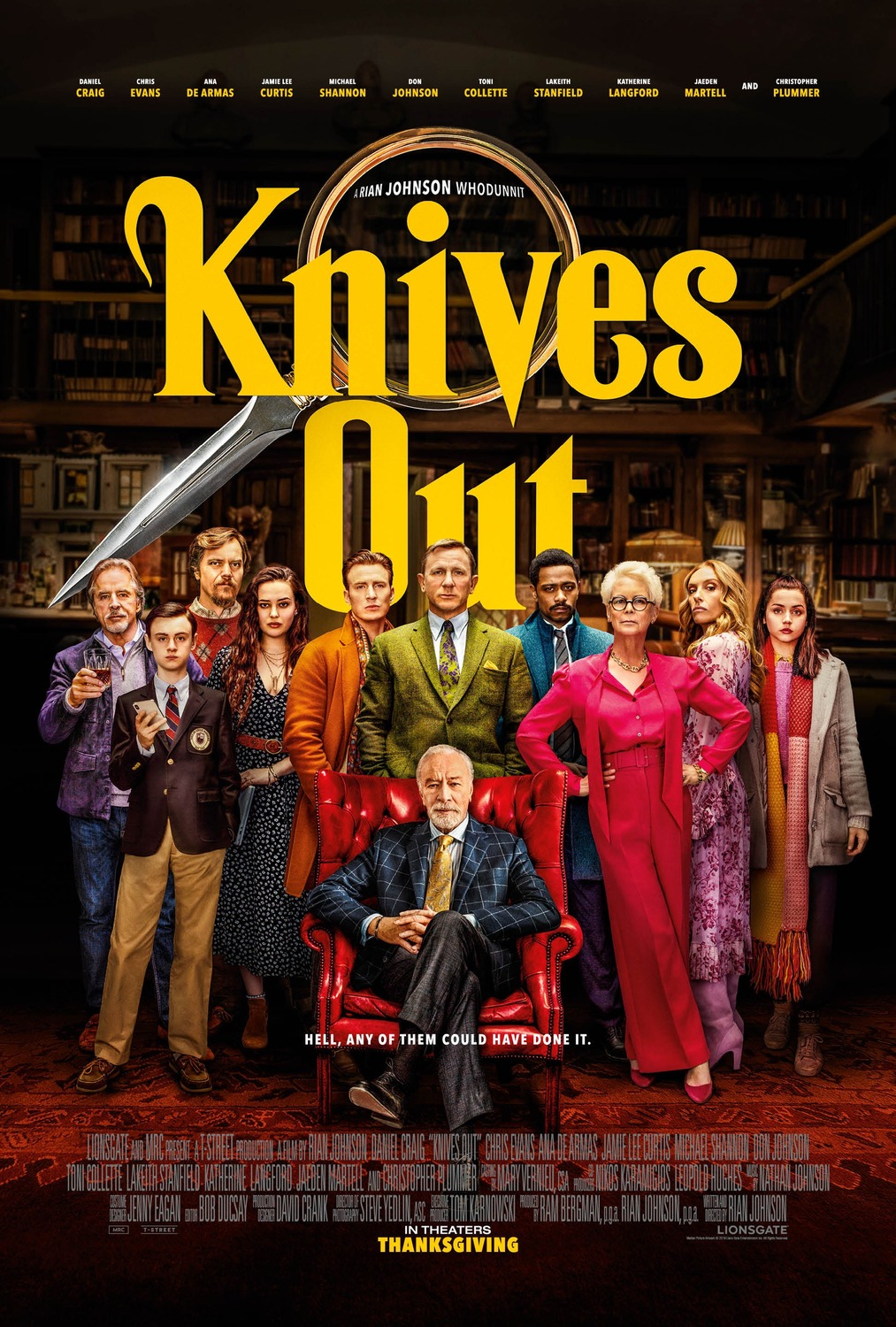
I grew up enjoying those Agatha Christie murder mystery movies like "Murder on the Orient Express" (1974 and 2017) and "Death on the Nile" (1978) and other similar themed films, like "Last of Sheila" (1973), "Clue" (1985), "Gosford Park" (2001) and even "Murder Mystery" (2019). The elements of the plot are generally similar. Someone is murdered in a confined place. Everyone there had a credible motive, so whodunit?
Millionaire mystery writer Harlan Thrombey gathered his family in his remote mansion to celebrate his 85th birthday. In attendance were his centenarian mother Wanetta, eldest daughter Linda (with her husband Richard Drysdale and son Hugh Ransom), son Walter (his wife Donna and son Jacob) and daughter-in-law Joni (with her daughter Meg). His personal nurse Marta Cabrera was also on hand to give him his nightly injections of ketorolac (given at a very high dose of 100 mg - - a glaring medical goof) and morphine.
The morning after the party, the housekeeper Fran discovered Harlan dead in his room with his neck slit. Aside from the local police, famous private detective Benoit Blanc had also been anonymously hired to investigate the case. While the initial cause of death was thought to be suicide, personal motives for wanting to kill Harlan among the family members crop up under questioning. After Harlan's will was read, the shocking provision of the will caused the tension of the situation to go into full chaos.
Daniel Craig played the Hercule Poirot-inspired private eye Benoit Blanc tongue-in-cheek with that affected Southern drawl, probably distinguish this character from his more famous character James Bond. Every actor in the all-star cast -- Jamie Lee Curtis (as Linda), Don Johnson (as Richard), Chris Evans (as Ransom), Michael Shannon (as Walt), Toni Collette (as Joni) and Christopher Plummer (as Harlan) -- were hamming it up like crazy, it was a lot of fun to watch. Caught in the middle of all that family madness was Ana de Armas as the mousy nurse Marta (whose country of origin changed every time it was brought up). Muppet and Yoda meister Frank Oz appeared in a cameo as Harlan's attorney.
With obvious reverence to Dame Agatha Christie, writer-director Rian Johnson has crafted a neat little mystery that got more and more complicated along the way. Despite knowing beforehand some inside information that even Detective Blanc did not know yet, the viewer will still keep on guessing whodunit right up to the final revelation of the full solution. While the cast played it up in high camp fashion for entertaining effect, Johnson unraveled his mystery story masterfully, with suspense and logic fully intact. 8/10.