Friday, January 24, 2020

Review of D'NINANG: Meeting a Missing Mother

January 23, 2020


This past decade, Ai Ai de las Alas was being noticed more for her indie dramas "Ronda" (2014), "Area" (2016) and "School Service" (2018). In 2017, she had two comedies, "Bes and the Beshies" and "Our Mighty Yaya," both of which were maligned by critics. She returned in 2019 with three consecutive bombs: "S.O.N.S (Sons of Nanay Sabel)," "Feelenial: Feeling Millennial" and "And Ai, Thank You." Unperturbed, Ai Ai is back again this year with yet another comedy-drama called "D'Ninang." 

Ditas was the leader of a gang of pickpockets operating in Cubao. Among the members of her gang were the drunkard Lolo Medi (Lou Veloso), the street-smart Sol (Angel Guardian), the flirty Lorena (Kiray Celis), while Gracia (Joey Marquez) was a policeman she had under her payroll. Like a "Robin Hood," Ditas would generously provide financial and material help to everyone in her neighborhood who would request for her help, earning her the nickname of "Ninang" or "Godmother."

One day, Ditas visited the wake of a former boyfriend, she got reunited with her teenage daughter Mikhai (Kisses Delavin) whom she abandoned all those years ago. When Ditas brought Mikhai to live with her in Cubao however, things went topsy-turvy trying to hide her illegal operations from her crime-hating daughter. So Ditas decided to finally change her ways and say goodbye to her life of crime. However, it was not going to be that simple for Ditas to turn over a new leaf. 

As Ditas, Ai Ai de las Alas is in another mother role, a role that had been a good luck charm for her. She became a box-office star in the first decade of the new millennium and earned the title of Comedy Queen with the "Tanging Ina" films (2003, 2008, 2010, 2011). Even in her last film, Coco Martin's MMFF 2019 entry "3pol Trobol: Huli Ka Balbon!," she played Coco's mother. So her role here as Ditas was not exactly too much of a stretch for her acting skills as this was right in her comfort zone of comedy and drama. She had not lost her touch for wry self-deprecating humor, despite the limitations of the material.

The young actors in the cast provided some diversion from Ditas' story. Kisses Delavin played Mikhai, a bitter daughter who found it hard to forgive a mother who was never there for her. Her rude behavior towards Ditas was not easy to watch. The winsome McCoy de Leon made a great impression as Kali (short for Kalayaan), the schoolmate smitten by Mikhai's charms. A new young actress named Angel Guardian played the role of Sol, an orphan who grew up with Ditas as her partner in crime. She had good screen presence beside these more known actors, but maybe she has to change her screen name to be taken more seriously as an actress. Noted ENT surgeon Dr. Kirt Delovino registered well on the big screen as a compassionate heart surgeon. 

From the poster alone, you knew that this was going to be a "jologs" comedy. There would be some dramatic elements, following the success formula of the "Tanging Ina" films.  Director GB Sampedro told his story in an easygoing manner, even if the main plot is largely predictable. The gags were mostly old and not all worked, while true LOL moments came few and far between. Even then, I'd say this film was not a total waste of time for those enjoy this type of popcorn, lowbrow comedy, largely thanks to the efforts of its actors. 

The thing that bothered me most was the MTRCB rating of G. From the very first scene up to its Mexican standoff climax, there were scenes showing blatant crimes being committed. At first, these petty thievery were even shown to be perpetrated by children. There was a character praying for forgiveness in church, but would steal from the pockets and bags around her at the same time. There was a sequence where a pawn shop robbery was described and shown step by step. These crimes may have been done in a comic way, but just the same, this should have been rated PG at the very least, not G. 5/10. 


Thursday, January 23, 2020

Review of NIGHTSHIFT: Madness in the Morgue

January 23, 2020


Yam Laranas is a Filipino director and cinematographer whose specialty lay in horror films. He will be remembered for "Sigaw" ((2004), which was actually picked up by Hollywood for an American remake, "The Echo" (2008), which was also directed by Laranas. His other memorable films include The Road (2013) and Aurora (2018). For his latest work, Laranas once again revisits his favorite genre. 

Jessie (Yam Concepcion) was a young Med Tech graduate who decided to work as a morgue assistant for pathologist Dr. Alex (Michael de Mesa) first before going on to medical school. On this particularly busy night duty, there was a supertyphoon raging outside, and her replacement could not come on time. Overworked and sleepy amidst all the cadavers, Jessie began to hear eerie sounds, witness terrifying visions and have ghastly nightmares, even as Dr. Alex entertained her with sick scare pranks, facts about dead bodies and discussions about the afterlife.

Yam Concepcion spent the whole time looking tired and confused as Jessie. She definitely made you feel her stress and exhaustion. She had been on morgue duty for more than 24 hours so I don't blame her cabin fever. Even then, Jessie was very devoted to her duty, despite how cruelly it seemed to be playing with her mind. I am not really sure why she kept on obsessively mopping and scrubbing the floor even though there were no spills shown the scene before.  However, when unexpected revelations were made at the end, there would be a lot more questions which would arise about Jessie rather than those answered. They should have been more careful about her interactions and other details.

The presence of Michael de Mesa as Dr. Alex was a reassuring one. However, the good doctor was quite unpredictable in terms of behavior. I guess spending day in and day out dissecting corpses could take it toll on one's psychological makeup and sense of humor. They could have finished the arc of his character better. Character actors were cast as side characters who complicated Jessie's night even more, like Epy Quizon and Soliman Cruz (as the thieving aides), Ruby Ruiz (as the head nurse), Irma Adlawan (as the hysterical mother) and Mercedes Cabral (as the very late co-worker). 

A morgue was also the claustrophobic setting of a recent Hollywood film entitled "The Possession of Hannah Grace" (Diederik Van Rooijen, 2018). Therefore I cannot help but to see several similarities with the horror gimmicks employed in both films. I guess there are only so many scares you can cook up in the confines of a morgue. Most of them should be quite predictable already, like flickering lights, dark shadows, unsettling noises, breathing corpses, moving corpses, missing corpses, being trapped in a freezer, and the like. In contrast with Hannah Grace's modern morgue, Jessie's morgue was much older, creakier and had more character to its credit. 6/10. 


Monday, January 20, 2020

Review of THE GRUDGE (2020): More Madness and Murder

January 18, 2020


The original "Grudge" movie was the 2002 Japanese horror movie "Ju-On" by Takashi Shimizu, It originated a story about how when someone dies in the grip of a powerful rage, a curse is born. This curse possessed the house where this death occurred and would corrupt anybody who made the mistake of entering that place. It introduced us to the vengeful ghosts of  Kayako, a Japanese woman with long hair covering her face, and her son Toshio, a little boy with wide open black eyes. 

This film got an American remake in 2004, also directed by Takashi Shimizu, involving Americans who moved into the house in Tokyo where the curse originated. There had been several subpar sequels in both Japan and the US over the years, culminating in a cheesy crossover featuring the two foremost long-haired lady ghosts of Japanese cinema, Sadako (of "The Ring) and Kayako (of "The Grudge"). 

The US decided to reboot the 2004 film again this year, bringing the curse to the USA. Like the original movie, the film would jump back and forth in time from 2004 to 2006 to tell the story of four families upon whom the curse had descended. It all started when an American caregiver who worked in the original Tokyo house where the curse began went back home to her home in suburban Pennsylvania. Since then, everyone who went into their cursed address of 44 Reyburn Drive would see ghastly visions which led to madness and murder. 

The whole atmosphere is dark and eerie as would be expected from the horror film like this. The musical score and shocking sound effects all contributed to this Director Nicolas Pesce certainly knew how to build up the suspense for a jump scare, though some may be predictable. He did not shirk from showing disturbing, gory or bloody images of all sorts, not just limited to long-haired ladies in white this time around. I cannot say that all the scares worked as Pesce planned, but at least they did keep audiences at the edge of their scenes. 

There was no Sarah Michelle Gellar in this reboot, but there are familiar faces like John Cho (as a real estate agent), Jackie Weaver (as an assisted suicide counselor) and Andrea Riseborough (as a harrassed cop). But of course, the best (or in this case, the most disgusting) scene of all belonged to none other than American horror film superstar, Ms. Lyn Shaye. As the demented Ms. Faith Matheson had her back turned while working at the kitchen counter with a chopping knife. I will give you three guesses what she was chopping. That scene alone was worth the price of admission for me. 6/10. 


Sunday, January 19, 2020

Review of RICHARD JEWELL: Stereotype Slander

January 18, 2020


Richard Jewell (Paul Walter Hauser) was an odd fellow. At the age of 34, he was single, obese, not too bright, can't hold a job and still lived with his mother Bobbi (Kathy Bates). In 1996, he worked as a security guard at Centennial Park where they held concerts for the Atlanta Olympics. One night, he noticed an abandoned bag on the grounds near the tower which was later confirmed to be a bomb. Richard was hailed as a hero at first. 

However, when FBI agent Tom Shaw (Jon Hamm) leaked to a persistent reporter Kathy Scruggs (Olivia Wilde) that they were investigating Richard as a possible suspect for the bombing. This was because he fit the stereotype of a false hero -- someone who purposefully caused an emergency so that he can be there to save people from it. When Scruggs went for it and made it headline news, Richard's life was turned upside down. 

This film was a strong statement against how irresponsible law enforcement and mass media together can destroy one man's life. These two organizations were expected to uphold only the truth, and not act upon mere suspicions unsupported by reliable evidence. There was no way that one powerless private citizen can stand up against these two superpowers when they bear down on him with all their collective might. 

Being Richard Jewell was a thankless role for lead actor Paul Walter Hauser. While it is his the role of his lifetime, it could lock him into similar roles of redneck losers. His rather low-key performance of a low-key yet challenging role failed to get the critical acclaim it deserved. Kathy Bates can really spin her own magic out of any small familiar role, like this one as a loving supporting mother. Her plea for her son's innocence in that presscon scene alone was enough for her to bag an Oscar nomination for Best Supporting Actress. 

Sam Rockwell is in right his serio-comic element as Watson Bryant, a small-time attorney who stepped up from his sleepy practice to be Richard's attorney in a case of national interest. Jon Hamm and Olivia Wilde were effectively slimy in their roles of a prideful FBI agent (a composite character) and a unscrupulous news writer (controversially based on a real-life journalist), respectively.

As director of true-to-life stories like "American Sniper" or "Sully," Clint Eastwood is very traditional in his style of storytelling -- cut and dry, no fancy embellishments. While his simple style certainly fit these types of stories, the viewing experience feel bland or mechanical at times. In "Richard Jewell," the blocking of the crowd in the concert scenes looked awkward and unrealistic, with a long Macarena dance scene to boot. The interposition of Bryant's investigation of how much time Richard had to walk to the payphone with Michael Johnson's record-breaking 200m dash victory felt forced. 

However, it cannot be denied though that Eastwood effectively showed the horrors of a trial by publicity, along its urgent cautionary message to the government and the press not to carelessly throw unsubstantiated accusations casually without due regard to the constitutional rights of the persons involved. With the dawn of social media, the message is all the more valid now as it was before, in the US, our country and all over the world. 7/10. 

Friday, January 17, 2020

Review of MIA: Healing the Hurt

January 17, 2020


When Noah proposed to Mia, the happy occasion was marred by a freak accident. Emotionally wrecked, Mia gatecrashed a wedding party held on a beach in Palawan and made a big scene with her drunken speech. She almost drowned when she ran into the water but she was rescued by the best man, Jay. 

Dr. Mia Salazar was an MD, a "doctor to the barrio" working at the local hospital. Dr. Jay Policarpio had PhD in forestry, and enjoyed spewing random facts and statistics about the environment. Despite the huge differences in personality, especially their drinking habits, the two hit it off quite well. However, Mia's past would always get in their way.

This unconventional love story begins with a traumatic event which left our titular heroine Mia shell-shocked and a drunken mess for practically the rest of the film. Although it was treated as comedy in the film, I saw it as actually a warning against how alcoholism clouded judgement and sense. The term "alcohol amnesia" was brought up to describe Mia's condition of totally forgetting what she did while under the influence. Colleen Garcia may be a little uneven being a comic (like when talking drunk nonsense to her pet bromeliad plant Bru), but she was cute doing it. Her tears though were very affecting.

Because of Jay's occupation as a forester, the film also took its opportunity to espouse several environmental concerns from climate change to open-pit mining. Some people may criticize this as mere padding, but I thought it was nice the way they integrated science into the script with Jay's quirk for regurgitating facts and figures. Although his mini-lectures may not always be as stimulating as he'd like, Edgar Allan Guzman effectively delivered being this charming nerd.  I also liked the neatly shelved rock collection Jay had in his room, a very interesting detail hardly seen in local films. 

This is the first Filipino film released this year, and as such, the first Filipino film of the whole decade. Casting an untested pair of actors as a leads in a rom-com is really a big risk for the producer. Several rom-coms last year ended up in the red because of its non-star casting, but they also had weak scripts to blame. But then, there are notable exceptions like "Write About Love" with novel casting but a great script. "Mia" may have a rather unimaginative title, but this latest work by director Veronica Velasco is actually quite good and deserves to be given a chance to do well at the box office. 7/10. 

Thursday, January 16, 2020

Review of JOJO RABBIT: Sensible Satire

January 15, 2019


Movies about Nazi Germany are usually deadly serious, but here's one film who decided to portray Nazi atrocities as a black comedy. The audacious director who dared to do this feat is Taika Waititi, a New Zealander filmmaker who broke through to international fame after directing the hilarious "Thor: Ragnarok" in 2017. This time, Waititi adapted Christine Leunen's best-selling novel "Caging Skies" himself and directed it to become one of the most critically-acclaimed films of 2019. 

It was World War II in Nazi Germany. Johannes "Jojo" Betzler was a ten-year-old boy living with his mother, Rosie. His father was away fighting in the war somewhere, while his sister Inge died of influenza. To keep himself amused, Jojo had an imaginary friend -- a foolish Adolf Hitler -- from whom he asked advice. When Jojo balked at killing a rabbit at Capt. Klenzendorf's Hitler Youth training camp, he was teased with the nickname "Jojo Rabbit." He would later discover a dangerous secret her mother kept in a wall in their upstairs room.

Waititi pushed envelopes to write the notorious Hitler as such a stupid childish caricature on film, even if he was just a figment of a child's active imagination here. And being the comedian that he was, Waititi even played this version of Hitler himself, toothbrush mustache, pot belly and all. To push the Nazi satire further, the whole Nazi Youth training camp scenario was also very comically envisioned and executed, with Sam Rockwell and Alfie Allen as the inept officers who run it. With Rebel Wilson playing a hefty fraulein instructor there, you can see how riotous that could be. 

The boy Jojo was played by 12-year old child actor Roman Griffith Davis, in his very first film role. His role was complex with the ethical decisions which his character faced as a young boy, but Davis was able to play it delightfully light with wide-eyed innocence, as Waititi envisioned the role. Scarlett Johannson played his mother Rosie, who wanted to instill in his fiercely loyal Nazi son a sense of compassion, to offer an antidote to his budding toxicity. Johansson earned an Oscar nomination for playing this Supporting role (on top of her Best Actress nomination for "Marriage Story" -- a rare double nomination). 

As writer and director, Taika Waititi infused his wacky sense of humor into Leunen's grim book. Making fun of Hitler and Nazi Germany is definitely not expected to everybody's cup of tea, but he went for it. Compared to the riotous gag in "The Producers" where Hitler was a very gay flamboyant dancer, Waititi's version of Der Fuhrer was silly but still maintained some sinister in him. Waititi treated Jojo's unexpected discovery about a certain girl (played by Thomasin McKenzie) with tenderness and sensitivity. 

Tackling the relationships of Nazis and Jews in films is always a touchy subject. I guess Waititi, while trying to be edgy and funny about it, had still managed to tread that precarious line well enough to merit nominations of Best Picture and Adapted Screenplay from the usually conservative Academy. 8/10.


Sunday, January 12, 2020

Review of 1917: Fluidly Following

February 6, 2020


It is April of 1917 in the trenches of the British troops in Northern France during the First World War. Two young soldiers, Schofield and Blake, were given a mission to hand-deliver an important intelligence letter across enemy lines to the commander of another British battalion to call off their planned attack on a German camp because they were prepared to ambush them. Blake was specially wired for this mission despite its dangers because his brother Joseph was in that other battalion. 

From the very first scene to the last, director Sam Mendes and cinematographer Roger Deakins took us along for what looked like one single take of continuous action as the camera followed Schofield and Blake in what seemed to be real time. It was an incredible technical achievement how they did this fluid illusion as the camera followed the two soldiers and show us their surroundings from all aspects. This becomes even more remarkable when they incorporate complex scenes, like a plane crash or a battle charge or even a slowly dying soldier, all integrated perfectly in time with the flow.

Following a mission real-time also meant having screen time spent on simply walking and chatting through trenches and fields, which others may find tedious. However throughout this long walk of the two soldiers, it was the musical score of Thomas Newman that brought color to what may seem like simple images and action on the screen. The ever-changing tempo of the music created an atmosphere of tension and impending peril, and was very much a significant aspect of the entire movie-viewing experience for this film. The detailed art direction, costumes and makeup complete the harrowing picture.

Playing the two soldiers whose lead we followed were George MacKay as Lance Corporal Will Schofield and Dean-Charles Chapman as Lance Corporal Tom Blake. I only knew Chapman as Tommen Baratheon from the "Game of Thrones." I did not recognize MacKaye even if he had a longer career behind him, but this was his biggest breakthrough role internationally in a most challenging role. Along their way, there were cameos from more prominent British actors playing other soldiers they encounter, like Mark Strong (as Capt. Smith), Colin Firth (as Gen. Erinmore) and Benedict Cumberbatch (as Col Mackenzie). 

With a broad encompassing title like "1917" and all the awards buzz that surrounded it after it premiered, I was expecting one major epic war adventure. However, it turned out that the adventure we were going to follow for the next two hours was of a much smaller scale -- following the mission of two lance corporals to deliver a vital letter. While the mission was indeed distressing and fraught with unexpected episodes of danger, I will not deny that I was a little surprised by the thinness of the story being told. However, Sam Mendes more than compensated for this with his incredible camera techniques. 9/10. 


Thursday, January 9, 2020

Review of CATS: Freakish Felines

January 9, 2020


Since it was released in the US last month, "Cats" had been receiving one scathing review after the other. It had been called not only one of the worst movies of the year 2019, but one of the worst movies of the whole decade. Financially, it was one of the worst box-office duds of the year, so far earning barely half of its $90M production budget. Honestly, my main reason for watching this movie was so see for myself how bad it could be.

I am a big fan of musical theater, but Andrew Lloyd Webber's "Cats" is not really a favorite of mine. When we watched it performed live by a touring production locally, I did not really like it. I did not get why this musical had been as popular and long-running as it was. I cannot envision how such a practically plot-less musical could be adapted to the big screen as a movie. Hence, I really went into watching this film with very, very low expectations. 

Like the original musical, the movie also told about the Jellicle Ball, one special night among the Jellicle cats of London when one of them would be picked by their tribe elder Old Deuteronomy for rebirth into a new life. However, the film script tweaked the role of young white cat Victoria (played by English ballet dancer Francesca Heyward), from just a featured ballet dancer in the musical, into the main character of the film version. It was also for her benefit that the various cat characters (Jennyanydots, Rum Tum Tugger, Bustofer Jones, Skimbleshanks, Mungojerrie and Rumpleteazer) were introducing themselves in their own song and dance numbers. 

The catchy songs "Jellicle Songs for Jellicle Cats," "Mister Mistoffelees" did not have the energy of the stage productions. As for "Memory," I do not think Jennifer Hudson (as the faded Glamour Cat Grizabella) gave it the appropriate emotion and interpretation. To be fair, I did like the "Skimbleshanks: The Railway Cat" number, with its lively tap dance sequences led by Australian ballet dancer Steven McRae as Skimbleshanks. Taylor Swift appeared as sexy catnip-sprinkling cat Bombalurina sang the song "Macavity: The Mystery Cat" as pro-Macavity, unlike the original Bombalurina in the play who was anti-Macavity. Jason Derulo's Rum Tum Tugger and James Corden's Bustofer Jones had forgettable song numbers.

As far as the much-maligned fur CGI for the cats, they were really looked creepy and cringey. The worst offender is that of Rebel Wilson's skin-stripping, cockroach-chomping Jennyanydots. The cat facial make-up was not good for most, especially for Judi Dench (gender-switched in the role of Old Deutoronomy), Idris Elba (as a nightmarish Macavity) and Jennifer Hudson (whose brown make-up looked awful on close-up). The sizes of the sets do not seem consistently proportional to the size of the cats in various scenes, which can be distracting. There was something about how the songs were sung that sapped all sense of heart from them, making the whole film a terrible bore.

I thoroughly enjoyed director Tom Hooper's take on "Les Miserables", but sadly he totally dropped the ball on this one. 2/10. 


Wednesday, January 8, 2020

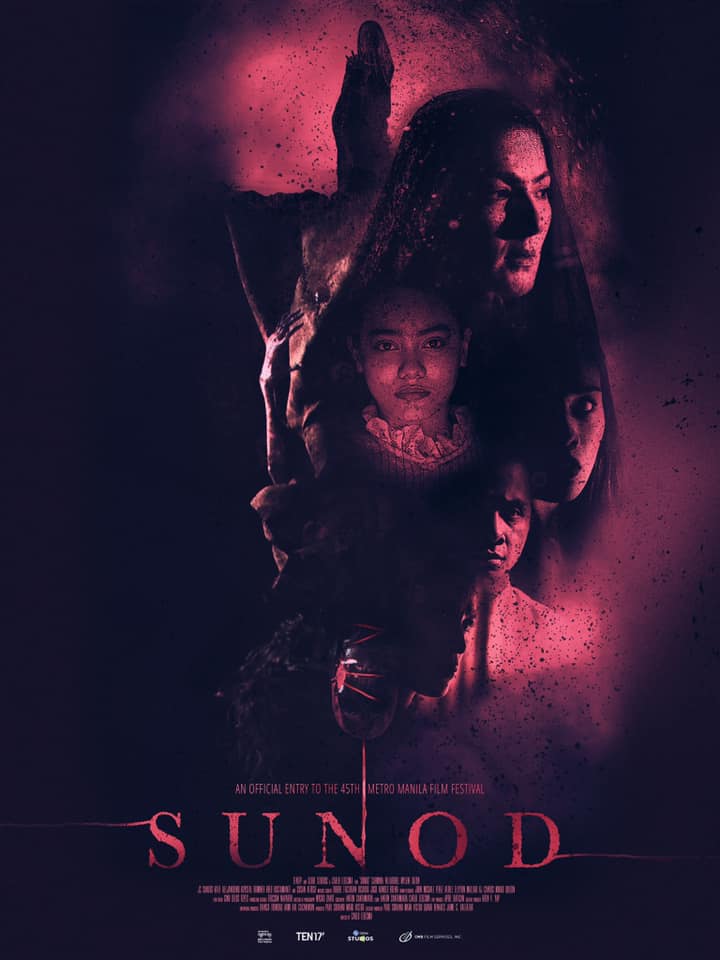
MMFF 2019: Review of SUNOD: Maternal Mission

January 8, 2019


Since its inception, there would at least be one horror film in the Metro Manila Filmfest, from the "Shake, Rattle and Roll" series to the numerous Kris Aquino shockers. There was actually supposed to have been another Kris Aquino horror this year entitled "(K)Ampon," but was pulled out due to technicalities. Of the two left, this one "Sunod" was chosen as an entry to the festival and actually won 3rd Best Picture, while the other one "The Heiress" was already shown earlier this month to lukewarm reviews.

Olivia Sazon was a middle-aged woman whose daughter Annelle was suffering from a congenital heart disease. Surgery was needed, so Olivia applied for a job as a call center agent for LGO (short for Liboro Global Outsourcing). This center operated on the fourth floor of the pre-WWII vintage Liboro House in Escolta, a building that used to be a hospital in the 1970s. One night, Olivia befriended a young girl named Nerisa who was seemingly lost. Later though, it seemed Nerisa was a ghost, and she followed Olivia home.

There was much promise to this horror film at the start. The cinematography (by Mycko David) looked great despite the dismal weather and locations. The soundscape and macabre musical score made sure we felt the dread and danger.  As the main setting, the Liboro House was very much a character in the story in itself. Its long tragic history, empty second and third floors, ancient elevator, and sputtering unstable power supply all made sure that we feel that place was undoubtedly haunted. 

Essentially, this was tale of two mothers and two daughters. The central character was Olivia, one of the mothers. For her restrained performance in this role of a desperate mother, Carmina Villaroel deserved her nomination for Best Actress, as she did some of the best acting work I had seen her do lately. The other mother was Perla, played by the ever-reliable Susan Africa, whose startling role in the story will surely leave an indelible memory despite only appearing in the last half hour or so. 

The two daughters were played by a couple of young actresses whom I first saw in action in a couple of Erik Matti films: Kristal Brimner from "Honor Thy Father" (2015) and Rhed Bustamante from "Seklusyon" (2016). Aside from rising to the challenge of playing a possessed girl, Brimner also got to showcase her guitar-playing while singing the song "Inay". With the spooky gray make-up on her face, Bustamante struck dread as the ghostly girl from the shadows looking for her lost mother.

Among the folk at the call center were Mylene Dizon (as Miss Karen Liboro, the stern and unsmiling COO of LGO), JC Santos (as Lance Santos the overly "friendly" team manager) and Kate Alejandrino (as Mimi, the perpetual call center trainee who befriended Olivia). Freddie Webb had a brief appearance as the infirm Don Jaime Liboro. Respected theater actors Teroy Guzman and Dolly de Leon played smaller roles as proud lawyer and mousy receptionist, respectively.

After an engaging and very riveting build-up, the climax was rather a confusing let-down. What were Perla and Nerisa really all about and what made them choose to torment Olivia and Annelle after all these years? While the red-colored yarn was a creepy touch, what really did it represent? There seemed to be some explanatory details left out in the editing room that made the ending a bit unclear. A back story about Perla and Nerisa's turn to the dark side would have been welcome. That said, this was still a solid directorial work for Carlo Ledesma. 7/10. 

Tuesday, January 7, 2020

MMFF 2019: Review of MIRACLE IN CELL NO. 7: Tangible Tearjerker

January 7, 2019


I have long known about a hit Korean movie entitled "Miracle in Cell No. 7" (Lee Hwan-kyung, 2013) which audiences loved as a tearfully emotional viewing experience. The positive word of mouth had been viral. However, I had not seen it yet despite its fame and status as one of the top ten biggest box-office hits in Korea of all time. 

Even before I got to watch it, Viva Films released a Filipino version of this film for the Metro Manila Filmfest 2019. Apparently, the appeal of its story was also very successful with Filipino audiences as this remake had overtaken the film of annual festival topnotcher Vice Ganda to top the final box office tally for the two weeks of the 2019 MMFF.

Joselito "Lito" Gopez (Aga Muhlach) was a mentally-deficient man who had a very close relationship with his six-year old daughter Yesha (Xia Vigor). One day, Lito got wrongfully accused and convicted of a serious crime involving the daughter of Secretary Yulo (Tirso Cruz Jr.). The case landed Lito in prison and incarcerated with tough criminals led by Boss Sol (Joel Torre) who all became his close friends.  Even the jail director Supt. Johnny San Juan (John Arcilla) eventually got won over by Lito's innocence and devotion to Yesha.

It was not surprising that many thought Aga Muhlach will win as Best Actor of this MMFF (but he did not). This role as Lito was very physically demanding because of the wacky childish antics he had to do to portray his character's mental retardation. Ok, there were times when these antics felt too over-the-top and even outright cheesy, but it cannot denied that those distinctive Aga Muhlach puppy-dog eyes worked their magic to make his dramatic scenes so emotionally evocative. 

It was also surprising that the winning performance of Xia Vigor as young Yesha did not win in the Best Child Performer category. Hers was a most endearing portrayal which would draw you in to shield and protect her from the harsh reality of her father's situation, as Yesha did to captivate her father's prison mates and even the bitter Sir Johnny. True that there were scenes when Vigor can get too cutesy, but Yesha's adorable naivete and kindness were truly irresistible even for the hardest hearts.

Lito's supportive cell mates, namely Boss Sol (Joel Torre), Bong (Jojit Lorenzo), Choi (Mon Confiado), Tatang Celso (Soliman Cruz) and Mambo (JC Santos), deserve a Best Ensemble award all their own. Of course, here they were more sympathetic and corny than hardened and fearsome, each with his own distinguishing little quirks and idiosyncrasies. John Arcilla were given his own side plot with moments to shine as the stern prison officer who could not move on from his own family tragedy. Bela Padilla had bookend roles as adult Yesha.

The script by Mel Mendoza del Rosario did well in his adaptation to set the Lito's story in the 1990s when the death penalty was still legal in the local setting. The production designer had to make sure their cell phones had to stick to their chosen time period. Director Nuel Naval, who once directed love teams James-Nadine in "This Time" (2016) and Richard-Dawn "A Love Affair" (2015), did absolutely everything to make sure his film will drain our tear ducts as the original famously did. With its massive box office take, I guess Nuel knew his audience well. 7/10. 

MMFF 2019: Review of MINDANAO: A Filipino Family in Focus

January 7, 2019


Saima Datupalo was a woman from Maguindanao who loved performing Muslim dances and telling Muslim stories. She had a four-year old daughter Aisa who had a tumor growing behind her right eye, and they had to travel to Davao City regularly for her chemotherapy. Meanwhile, her husband Malang was an Army sergeant-medic deployed on a series of dangerous missions against rebels, and so was frequently absent from their home. 

The most remarkable aspect that set this apart from other Brillante Mendoza family dramas was the use of colorful animated sequences of crayon drawings (by Team App) to tell the story of warrior brothers Raja and Suleiman and their grand battles with Pula and Ginto, the two vicious fire-breathing dragons which terrorized Mindanao. The editing of the animation with the live-action scenes were impressive. However, this epic story of bravery as told by Saima to entertain Aisa, while charming, never really connected clearly with the travails of the Datupalo family. 

Judy Ann Santos was consistently on point with her portrayal of Saima, and fully deserved the Best Actress accolades she had earned so far. She had big expressive eyes which can speak volumes of suppressed emotions, and this seemed to be a common feature of other central women characters in other Brillante Mendoza films, like Shaleha (played by Nora Aunor) in "Thy Womb" and Rosa (played by Jaclyn Jose) in "Ma'Rosa." 

Allen Dizon was his usual competent self as Sgt. Datupalo, and had effective emotional scenes with his wife and child, and his army buddy (played by Ketchup Eusebio). However, his screen time was actually shorter than would be expected for someone who won the Best Actor prize. 6 year-old child actress Yuna Tangog played the ailing Aisa with quiet strength. She portrayed some difficult scenes quite realistically despite her age and inexperience.

With a title like "Mindanao," one would probably expect a film with a grand story of epic proportions about the whole island. However, it turned out to be a simple story of one family who just happened to live in Mindanao, but their story could have easily been transposed to any other place in the Philippines. Director Mendoza made sure there were several touches of Muslim culture (religion, music, dance, legends, burial practices) intertwined within the telling of the story to remind us of the exotic setting. 7/10